
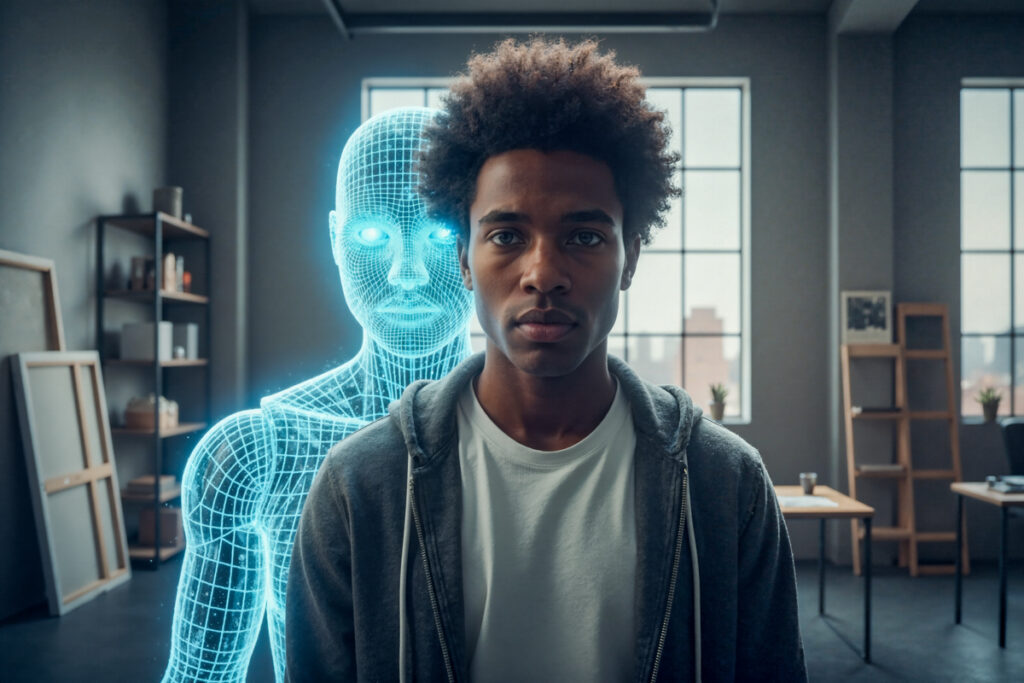
Every morning in 2025 feels like waking up to a new headline about artificial intelligence. A model that creates video from text. A tool that can design apps in minutes. A voice so real you’d swear it belonged to someone you know. For creators, this flood of innovation is equal parts thrilling and unsettling. The speed is breathtaking, but so is the uncertainty.
That tension, fear and excitement existing at the same time, it is what defines this moment for creators. AI is not something you “add on” to your work anymore; it has already seeped into every stage of the creative process.
How AI Slipped Into the Creative Workflow
I didn’t make a big decision one day to “start using AI.” It happened gradually, until I realized it was everywhere. Nudging its way into my daily routines the same way smartphones once did, until suddenly you can’t imagine working without it.
When I design a poster or ad, I’ll often create it myself first, then ask AI to critique it. It points out spacing issues, offers adjustments, even suggests ways to sharpen the tone. What used to take hours of second-guessing now takes minutes of conversation.
When I need ideas for a campaign, I don’t stare at a blank page anymore. I ask AI to spit out possibilities. Most of them aren’t perfect, but they get me moving. Even in production, it’s shaved off the small frustrations. I once spent 20 minutes painstakingly cutting hair out of a photo with a pen tool in Photoshop; now, I highlight it and it’s gone in seconds.
And then there’s coding. I’m not a full-stack developer, but with AI, I’ve built functioning web apps by describing what I want. That’s not a shortcut, it’s a door I couldn’t open before.
AI didn’t knock on the door of my work. It moved in, rearranged the furniture, and left me wondering how I ever managed without it.
The Allure: Speed and Scale
If there’s one word to describe AI’s power for creators, it’s speed.
An app that used to cost six figures and months of development can now be built over a weekend. A video ad that once required a production crew can be generated from a single product photo. A brainstorm that might take hours now happens in seconds.
But speed is only part of the story. What excites me most is the way AI removes limits. With image and video generation, I can test ideas I never would have attempted before. I can run experiments that used to require too much money, too much time, or too much technical skill. The freedom to try more, fail faster, and push boundaries, that’s the real benefit.
This has leveled the playing field in ways that are hard to overstate. A small creator can now put out ads that look like Tiffany & Co. produced them. A clothing brand can model their line on avatars walking down Fifth Avenue without ever leaving their bedroom. What was once locked behind big budgets is now within reach of anyone with vision and curiosity.
The Uneasy Side
Of course, there’s a shadow to all this progress.
AI’s ability to mimic styles raises real ethical questions. When a model can generate a painting “in the style of Picasso” or anime, where does inspiration end and exploitation begin? Artists have always borrowed, but AI borrows at the speed of code, often without credit or compensation.
Accuracy is another problem. AI can sound confident while producing nonsense. If creators publish blindly, we risk flooding the world with beautiful but false content. That’s why I believe speed doesn’t replace responsibility. The time AI saves should be reinvested in checking, refining, and ensuring the work is right.
And then there’s dependence. The more creators lean on AI, the more we risk losing the muscle of our craft. Worse, we risk blurring what it means to be a creator in the first place. If anyone can prompt an image or a video, does that make them a creator? Or is being a creator about something deeper, the ability to infuse work with originality and emotion? That’s the debate we’re heading toward.
Keeping the Human Edge
For me, AI is a collaborator, not a replacement. I’ll let it suggest, enhance, and accelerate, but the final creative voice has to be mine.
That’s because what matters most isn’t how polished something looks, it’s how it connects. Audiences might not care if a video was AI-assisted. They care if it resonates. They care if it makes them stop scrolling, laugh, or feel something.
We’ve seen this before. Filters once sparked debates about authenticity, and now they’re so normal we barely think about them. AI will follow a similar path. Eventually, it may be impossible to tell what was human-made or machine-made. Connection, not origin, will be the true measure.
What’s Coming Next
If AI feels big now, it’s only the beginning.
Today, AI can already take a single product photo and generate a full commercial with music and voiceover. In three to five years, that kind of capability won’t be impressive—it will be expected. I believe AI will not just support creative departments; it will be the department.
That doesn’t mean creativity dies. It means the definition of creativity changes. AI will flood the world with content, but only humans can bring the soul. Our edge isn’t in what AI can render, but in how we use those renderings to tell stories, move emotions, and build connections.
Redefining the Creator
This is where the question gets uncomfortable: what is a creator now?
If a teenager with no design training types a prompt and generates a flawless ad, does that make them a creator? Or is creation about more than output? I lean toward the latter. A creator isn’t just someone who produces; it’s someone who infuses their work with perspective and humanity.
That’s why I tell new creators not to treat AI as a crutch. Treat it as an amplifier. Use it to push ideas further, to experiment faster, to unlock doors you couldn’t open before. But don’t hand over the steering wheel. Your value isn’t just in what you can produce; it’s in the meaning you bring to it.
My Own Turning Point
For me, the clearest example of AI’s potential was in coding. I had the foundation but not the full training of a developer. Before AI, building a custom app or connecting APIs into a working platform would have been out of reach. With AI, I described what I wanted, and within hours I had something functional. That wasn’t just efficiency, it was empowerment. It gave me capabilities I simply didn’t have before.
The Next Generation
AI is moving too fast to stay in the background. It will reshape industries, challenge definitions, and raise questions we don’t yet have answers for. But I don’t see it as the end of human creativity. I see it as the next generation of it.
The creators who thrive will be those who embrace AI without surrendering to it, who let it expand their vision but not define it. Our job is to stay human, even as the tools around us become less distinguishable from us.
This conversation is just the start. Our AI for Creators course dives deeper into the tools, prompts, and strategies that can help you thrive in this new era.