
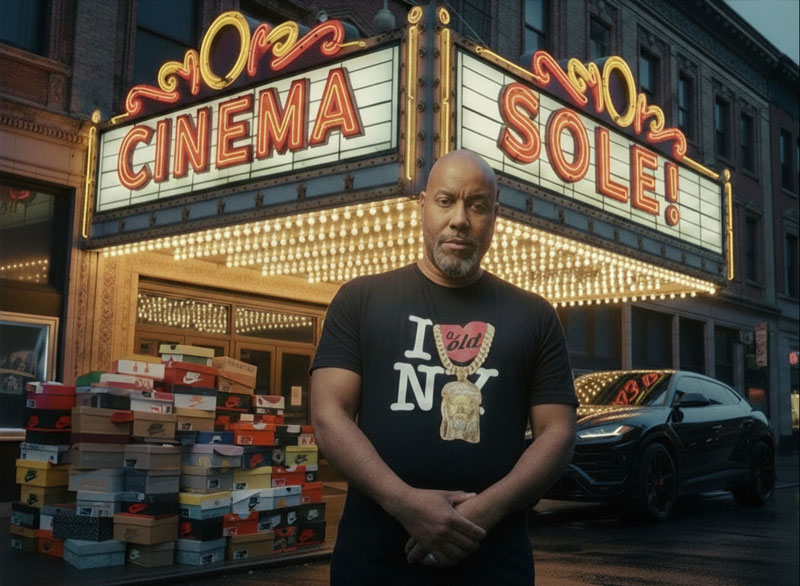
Sean “Opus 1” Williams (also known as Paperchasr of OSD) doesn’t just appreciate sneakers — he evangelizes them. The Brooklyn-born multi-hyphenate has spent more than a decade transforming his passion for kicks into a global education movement. Now, he’s bringing that expertise to MakingABrand.co with a new course: Cinema SOLE.
 Known worldwide as “The SneakerVangelisT,” Williams occupies a unique space in sneaker culture — not as a collector chasing grails, but as an educator building pathways into the industry for underrepresented communities. His work elevates sneakers from objects of desire to subjects worthy of cultural and academic study.
In 2013, he and co-founder Dee Wells began curating major exhibitions, including The Rise of Sneaker Culture, created by the Bata Shoe Museum in Toronto. Since then, their curatorial work has reached more than 13 million people worldwide, appearing at venues ranging from the Port Authority Bus Terminal in Manhattan to Capitol Hill for the Congressional Sneaker Caucus.
But contrary to what some might assume, the exhibitions didn’t come first.
“SOLEcial Studies actually started in 2011,” Williams explains. “We’re now in our 15th year and still pushing forward.”
“We use exhibitions as a way to open the door to conversations about sneaker industry education,” Williams says.
That educational mission has become the foundation of SOLEcial Studies — a curriculum that treats sneakers as wearable art, exploring their relationship to identity, design, commerce, and cultural movement.
His current exhibition, The SneakerVangelisT, running March 25 through April 5, 2026 at The Westport Library as part of VersoFest 2026, showcases one-of-one digital graphic works that reinterpret iconic sneaker models — some as ideal artistic canvases, others as celebrated muses. Each piece is, in his words, “a love and appreciation for kicks.”
Now, Williams is expanding the SOLEcial Studies curriculum with an online course made for the MakingABrand.co community: Cinema SOLE. The course explores how sneakers have functioned in cinema not merely as costume elements, but as narrative devices, character development tools, cultural signifiers, and brand-building moments.
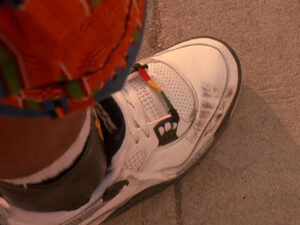 One of the clearest examples appears in Spike Lee’s Do The Right Thing (1989). In a pivotal scene, Buggin Out (Giancarlo Esposito) confronts a neighbor after his pristine Air Jordans are scuffed. The moment is more than comic tension — it foreshadows conversations about race, space, ownership, and the wave of gentrification that would later reshape Brooklyn itself.
“The scene was basically addressing and predicting what would later become an avalanche of gentrification in my native Brooklyn,” Williams notes.
Through moments like these — and others from films such as Back to the Future II, Forrest Gump, and He Got Game — the course reframes sneakers as cinematic storytelling tools.
Williams’ goal is simple but ambitious:
“My mission is for people to never see sneakers the same way ever again.”
Beyond cultural appreciation, there is urgency in that mission.
“The selfish goal is to educate and empower more women and people of color to actively and aggressively seek out careers in the sneaker industry,” he says. “It’s stale and predictable because it needs new people across the board. There’s room for everyone in this multi-billion-dollar global industry.”
For brand builders, marketers, and creatives, Sneakers in Film offers something rare: a case study in how objects become symbols, how products transform into cultural currency, and how authentic storytelling creates lasting brand value. Williams understands that sneaker brands mastered something many companies still struggle with—building communities that see their products not as purchases, but as pieces of personal identity.
The key lesson?
“The stories matter,” Williams emphasizes. “The ones behind the scenes that go into the making of a thing are just as important as the upfront story crafted to influence a purchase. Those two stories aren’t the same, but they’re both critical.”
That insight — the duality between origin story and marketing narrative — is where Cinema SOLE becomes a masterclass in brand strategy. It reveals how culture moves product, how symbolism builds equity, and how authentic storytelling sustains relevance across generations.
From Brooklyn streets to museum halls to cinema screens, Sean Williams has spent his career proving that when you study what people truly love, you uncover lessons that apply far beyond the object itself.
Cinema SOLE launches soon on MakingABrand.co. Learn more about Sean Williams’ work at solecialstudies.com.